
Synthetic Data, Overfitting, and the Brain as a Learning Machine
Abstract
Dreaming can be interpreted not merely as symbolic residue, random neural activation, or passive memory replay, but as a biological mechanism for improving generalization. In machine learning, overfitting occurs when a model becomes too adapted to the statistical peculiarities of its training data and fails to perform well on unseen examples. Artificial systems combat this problem through regularization, noise injection, data augmentation, dropout, generative replay, world models, and synthetic data. The brain faces an analogous problem: waking experience is limited, biased, repetitive, emotionally weighted, and locally sampled from an immense space of possible situations. This paper develops the thesis that dreams function as internally generated synthetic data: distorted, recombined, counterfactual, emotionally salient simulations that prevent the brain from overfitting to the narrow distribution of daily experience. The argument connects the Overfitted Brain Hypothesis, hippocampal replay, memory consolidation, predictive processing, generative models, continual learning, reinforcement learning, and dream-like synthetic training in artificial agents. A dedicated section addresses the question: do robots and machines dream? If dreaming is defined functionally as the offline generation of synthetic experience to improve generalization and reduce overfitting, then some artificial systems already implement dream-like mechanisms.
Keywords: dreams, synthetic data, overfitting, generalization, hippocampal replay, generative replay, continual learning, reinforcement learning, world models, machine dreaming, artificial intelligence
Table of Contents
- Dreams as a Computational Problem
- Overfitting, Regularization, and the Overfitted Brain
- Biological Mechanisms: Replay, Consolidation, Prediction, and Recombination
- Dreams, Nightmares, and Vivid Dreams as Reinforcement Learning Signals
- Psychosis as Pathological Overfitting: A Clinical Boundary Case
- Dreams as Synthetic Data: Emotion, Salience, and Creativity
- Do Machines Dream? Generative Replay, World Models, and Artificial Agents
- Predictions, Limits, and Conclusion
- References
1. Dreams as a Computational Problem
Dreams are among the strangest products of biological cognition. They are not literal recordings of waking life, but they are not detached from it either. They combine recent experience, remote memory, emotional residue, perceptual fragments, unstable identities, impossible spaces, counterfactual events, and physically implausible narratives. The dream world is often perceptually convincing while remaining logically unstable.
Historically, dream theory has moved through several major interpretations. In 1900, Sigmund Freud’s The Interpretation of Dreams framed dreams as symbolic expressions of unconscious desire and made dream interpretation central to psychoanalysis. Freud transformed dreams into a privileged route to the unconscious. But his framework often reduced the immense diversity of human experience to a narrow repertoire: desire, repression, family drama, and sexual symbolism. It was as if the entire dream life of humanity had been waiting patiently on a Viennese couch, only to discover that everything, somehow, led back to Freud’s own mother — as if all women were variations of her, and every human drama merely an echo of his own.
In 1977, Hobson and McCarley proposed the Activation-Synthesis Hypothesis, arguing that during REM sleep the pons and brainstem generate internal neural signals that activate the forebrain, which then organizes them into dream images, emotions, and narratives. In 1983, Francis Crick and Graeme Mitchison proposed the Reverse Learning Theory, suggesting that REM sleep may weaken undesirable patterns of neural interaction rather than strengthen them. In 2000, Antti Revonsuo introduced the Threat Simulation Theory, interpreting dreams as evolved virtual rehearsals for threat perception and avoidance. In the 2010s, memory-consolidation theories increasingly connected dreaming to the reactivation, stabilization, and integration of waking experiences during sleep, especially through hippocampal replay and sleep-dependent memory processing.
The contemporary AI perspective adds another layer: dreams may be computationally useful precisely because they are distorted. Hoel’s Overfitted Brain Hypothesis argues that dreams function like noisy or corrupted internally generated sensory inputs, analogous to data augmentation, noise injection, and other regularization techniques in deep learning. Their role would be to help the brain avoid overfitting to the narrow dataset of waking experience and improve generalization beyond recently encountered situations (Hoel, 2021).
This interpretation is reinforced by computational models of sleep and dreaming. Deperrois et al. show that perturbed and adversarial dreaming can help a learning system form robust latent representations — internal features that remain stable under noise and distortion — and extract semantic concepts, meaning higher-level structures that capture what an experience is about rather than merely its surface details (Deperrois et al., 2022). Franceschelli and Musolesi extend the same logic to reinforcement-learning agents, demonstrating how dream-like generative episodes can improve generalization in artificial systems (Franceschelli & Musolesi, 2024).
In machine learning, distortion is not necessarily a defect. It can act as regularization. Artificial neural networks are often trained not only on raw data, but also on transformed, corrupted, augmented, simulated, or generated data. These interventions prevent the model from memorizing irrelevant surface details and force it to learn more robust, abstract, and transferable representations.
The central claim of this article is that dreams may perform an analogous function for biological intelligence. Waking experience is the brain’s empirical training dataset: useful, but incomplete, biased by consciousness, attention, emotion, memory, and the narrow range of situations actually encountered. Dreaming may function as an offline generative process that perturbs and expands this dataset, producing synthetic samples that are strange enough to prevent literal memorization, yet structured enough to remain useful for learning and generalization.
In this view, dreams are not merely errors in cognition. They may be part of the brain’s anti-overfitting machinery.
2. Overfitting, Regularization, and the Overfitted Brain
In supervised machine learning, a model is trained on examples drawn from a dataset that only approximates the broader reality it is supposed to represent. The goal is not to memorize the training set, but to learn a function that captures the underlying structure of the problem and transfers successfully to unseen examples. A classifier trained on handwritten digits, for instance, should not merely remember the exact pixels of the training images; it should learn the more abstract features that make a digit recognizable across different handwriting styles, noise levels, rotations, and distortions.
Overfitting occurs when a model becomes excessively adapted to the statistical peculiarities of its training set. Instead of learning only the invariant structure that transfers beyond the observed sample, it also encodes accidental correlations, noise, sampling artifacts, outliers, and dataset-specific details. The result is a model that achieves low training error but fails to generalize: it has extracted apparent structure from patterns that may be contingent, rare, or merely coincidental.
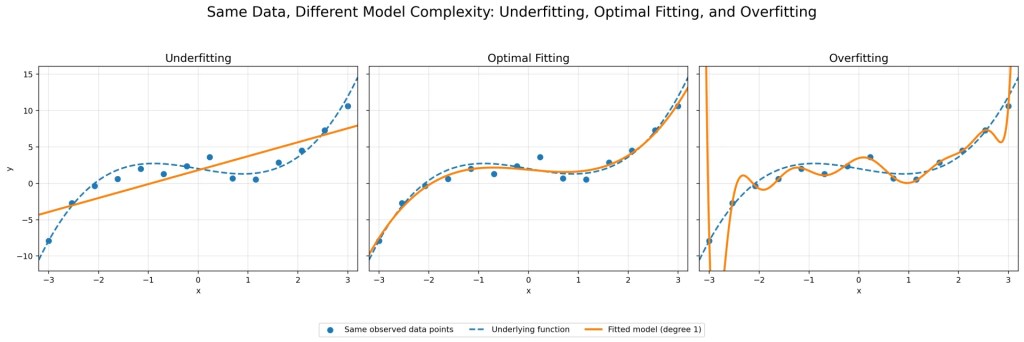
Technically, overfitting is observed as a generalization gap. During training, the loss (or error) on the training set continues to decrease, while validation or test loss stops improving, plateaus, or increases. This indicates that the model is no longer learning broadly useful representations, but increasingly fitting the idiosyncrasies of the training data. Such a model performs well on familiar examples but becomes brittle under distribution shift, noise, or variations not represented in the original dataset.

The brain faces a related problem. It is continuously trained by sensory, motor, social, and emotional experience. But waking life is not a neutral sample of reality. It is constrained by the body, environment, culture, routines, anxieties, rewards, social roles, and recent events. In statistical terms, waking experience is a finite, biased, temporally correlated dataset. A brain that adapted too closely to this local stream could become efficient in the short term but brittle in novel situations.
Machine learning reduces overfitting through several mechanisms: regularization penalties, dropout, noise injection, data augmentation, stochastic optimization, early stopping, synthetic data, and replay. The common principle is that learning must not collapse into literal memorization. A good learner must extract invariances — patterns that remain stable across transformations.
The Overfitted Brain Hypothesis applies this logic to dreaming. It argues that dreams evolved to improve generalization by exposing the brain to internally generated, noisy, corrupted, or augmented versions of waking experience (Hoel, 2021). Dreams are not faithful replays. They are bizarre, discontinuous, emotionally intense, spatially unstable, and semantically hybrid. This is exactly what one would expect if dreaming functioned like biological data augmentation.
A dream may contain a real person in an impossible location, a familiar room with altered geometry, or a recent anxiety embedded in a fictional crisis. Computationally, this resembles a perturbed sample drawn from an internal generative model. The dream preserves enough structure to remain meaningful, but corrupts enough detail to prevent the brain from over-identifying with literal experience.
The dream is therefore not simply replaying the training dataset. It is transforming and expanding it.
3. Biological Mechanisms: Replay, Consolidation, Prediction, and Recombination
Sleep is strongly associated with memory consolidation. During sleep, neural activity patterns related to waking experience can be reactivated. In hippocampal replay, sequences associated with spatial navigation or episodic experience reappear during rest or sleep. This replay is thought to support memory stabilization, integration, and in some cases planning (Ólafsdóttir et al., 2018).
However, dreaming cannot be reduced to replay alone. Replay means reactivation. Dreaming implies transformation. The dream does not merely retrieve stored traces; it recombines them into new configurations.
A useful technical distinction is:
Replay: reactivation of previously encoded neural patterns.
Consolidation: stabilization and integration of memory traces into broader cortical networks.
Generative recombination: production of novel synthetic scenarios by sampling from memory, emotion, prediction, and imagination.
Dreaming likely sits at the intersection of these processes. The hippocampus may provide episodic fragments. The neocortex may provide semantic and perceptual structure. The limbic system may provide emotional weighting. Predictive systems may generate possible futures, threats, conflicts, rewards, or social outcomes. The result is not a replayed video of the past, but a synthetic simulation assembled from multiple cognitive sources.
Predictive processing helps explain why dreams feel real despite being unstable. In predictive theories of the brain, perception is not passive reception of sensory input. It is active inference: the brain generates predictions about the causes of sensory signals and updates those predictions through prediction error (Friston, 2010). During waking life, external sensory input constrains the generative model. During dreaming, that constraint is weakened. The brain continues to generate perceptual worlds, but those worlds are driven more strongly by internal dynamics.
This is why dreams can be vivid yet structurally incoherent. The generative machinery remains active, while normal error correction from the external world is reduced. The brain samples from its own model.
From a learning perspective, this matters. A system that learns only from direct external input is limited by the narrowness of its environment. A system that can sample internally can explore a broader hypothesis space. Dreams may therefore be interpreted as offline sampling from the brain’s generative model of the world.

4. Dreams, Nightmares, and Vivid Dreams as Reinforcement Learning Signals
Dreams can also be interpreted through the language of reinforcement learning. In reinforcement learning, an agent does not merely classify inputs; it learns which actions, policies, or internal states lead to desirable or undesirable outcomes. Learning is shaped by value: reward, punishment, threat, relief, avoidance, and prediction error. The brain is not only a pattern-recognition system. It is also a value-learning system.
From this perspective, dreaming may operate as an offline simulation environment in which the brain samples possible situations and assigns emotional or motivational value to them. A dream is not only a synthetic perceptual sample; it may also be a synthetic value scenario. It presents the brain with imagined social conflicts, threats, rewards, failures, escapes, losses, discoveries, or resolutions. These dream episodes may help update expectations about what matters, what should be approached, what should be avoided, and which situations require attention.
Pleasant or successful dreams may resemble positive reinforcement. They simulate desired outcomes, mastery, discovery, attachment, recognition, or relief. In such cases, the dream may strengthen approach-related representations and reinforce internal models associated with reward, competence, or social connection. The brain is not receiving an external reward, but it may still rehearse value-laden trajectories inside its own generative model.
Vivid dreams are especially relevant because vividness increases salience. Highly vivid dreams are often emotionally intense, perceptually rich, and easier to remember. This means they may carry greater weight in offline learning. In machine-learning language, they may function like high-weight training samples. In biological terms, they may reflect stronger coupling between memory systems, emotional systems, and perceptual simulation during sleep.
Nightmares can be interpreted differently. They often simulate threat, failure, helplessness, pursuit, loss of control, or unresolved danger. In a moderate and bounded form, this may have an adaptive function: the brain rehearses aversive scenarios in a safe offline environment, improving threat detection, emotional calibration, and possible coping responses. This interpretation is compatible with threat simulation theories of dreaming, in which dreams operate partly as virtual rehearsals for danger (Revonsuo, 2000).
In reinforcement-learning terms, nightmares may involve negative reinforcement, but only in the technical sense of learning through the reduction or avoidance of an aversive state. If a dream simulates danger and then allows escape, resolution, or emotional downregulation, the system may learn that certain responses reduce threat. However, recurrent nightmares without resolution may become maladaptive. Instead of regularizing the mind, they may repeatedly train the brain on a biased high-threat dataset. The result could be stronger threat priors, increased avoidance, and poorer emotional generalization.
This distinction is important. A nightmare is not automatically useful. A vivid dream is not automatically adaptive. The computational value of a dream depends on whether it produces flexible updating or rigid repetition. A dream that transforms fear into resolution may support learning. A dream that repeats fear without updating may reinforce overfitted threat models.
Thus, dreams and nightmares may all be understood as different forms of offline reinforcement learning. Pleasant dreams may rehearse approach and reward. Vivid dreams may amplify the learning signal. Nightmares may rehearse threat, avoidance, or failed prediction.
When adaptive, this process helps the brain generalize emotionally and behaviorally. When maladaptive, it may overtrain the mind on fear, threat, or unresolved conflict.
Dreaming, then, is not only generative regularization. It may also be value-based simulation: the sleeping brain explores not only what could happen, but what would matter if it did.
5. Psychosis as Pathological Overfitting: A Clinical Boundary Case
The dream-as-regularization hypothesis suggests a useful clinical boundary case: psychosis. If dreaming is a bounded, sleep-bound simulation that may help the brain loosen its attachment to recent experience, psychosis may be interpreted — cautiously and metaphorically — as a waking-state disturbance of inference in which internally generated predictions, salience signals, or model assumptions become too dominant.
In predictive-processing theories, perception depends on a balance between top-down prediction and bottom-up sensory correction. The brain continuously generates hypotheses about the causes of sensory input and updates them through prediction error. During ordinary waking perception, external evidence constrains the internal generative model. During dreaming, this constraint is temporarily weakened. In psychosis, a related imbalance may occur during waking life: internally generated signals may be treated as externally caused, or ambiguous stimuli may be interpreted through overly rigid, excessively salient, or poorly calibrated priors (Fletcher & Frith, 2009; Sterzer et al., 2018).
Hallucinations can be understood as perception-like experiences produced by maladaptive inference. An internally generated sound, image, bodily sensation, or fragment of inner speech may be assigned excessive perceptual confidence and inferred as coming from the external world. In machine-learning language, this resembles a model that has become too confident in patterns extracted from noisy, incomplete, or ambiguous data. It does not merely detect signal; it imposes signal where evidence is weak.
Delusions may represent a higher-level version of the same problem. If ordinary events, coincidences, or internal sensations acquire abnormal significance, the brain may construct an explanatory belief system around them. Kapur’s theory of aberrant salience proposes that dopamine dysregulation can make neutral or ordinary events feel unusually meaningful. Delusions may then emerge as attempts to explain these abnormal salience signals (Kapur, 2003).
The analogy with overfitting is useful but limited. An overfitted model extracts too much structure from limited or noisy data and becomes confident in rules that fail to generalize. Similarly, in psychosis, the brain may assign excessive structure to noise, coincidence, ambiguous perception, internal speech, or emotionally charged events. However, psychosis is not “just overfitting.” It is a complex clinical condition involving neurobiology, dopamine regulation, development, stress, trauma, cognition, social context, and environment.
The contrast with dreaming is crucial. Dreaming may be a bounded, offline, reversible form of generative simulation. It occurs during sleep, with reduced motor output and reduced external constraint, and may support flexibility by allowing the brain to explore distorted versions of experience. Psychosis, by contrast, may involve a waking-state failure of constraint, in which internally generated models, abnormal salience, or maladaptively weighted priors intrude into perception and belief.
In this sense, dreams and psychosis may sit on opposite sides of generative cognition. Dreaming is a temporary simulation that may help regularize the mind. Psychosis is a dysregulated inference process in which internally generated models can dominate waking reality.
6. Dreams as Synthetic Data: Emotion, Salience, and Creativity
Synthetic data is artificially generated data used to improve learning. It may come from simulation, procedural generation, transformations of real data, generative models, or counterfactual recombination. Synthetic data is valuable when real data is limited, biased, expensive, dangerous, private, or incomplete.
The brain faces similar constraints. It cannot expose the organism to every possible danger, social conflict, emotional loss, opportunity, spatial environment, or future decision. It must generalize from incomplete experience. Dreams may help by expanding the effective training dataset of the nervous system.
Dreams are synthetic, but they are not arbitrary. They sample from real cognitive materials: episodic memory, semantic knowledge, sensorimotor patterns, emotional salience, social models, threat templates, reward expectations, bodily states, and predictive simulations. Their function would not be to represent reality accurately. Their function would be to generate useful variation.
This also explains why dreams are often emotionally intense. Biological learning is not purely statistical; it is value-weighted. The brain must learn not only what happens, but what matters. Fear, shame, desire, grief, embarrassment, urgency, attachment, and threat often dominate dream content because these are high-salience domains for adaptive behavior. In machine-learning terms, emotional intensity resembles sample weighting: some examples matter more because the cost of error is higher.
Dream bizarreness may also support abstraction. A dream may not preserve the literal classroom, but it may preserve the structure of evaluation. It may not preserve the actual predator, but it may preserve the structure of threat. It may not preserve a real conversation, but it may preserve social tension. The surface changes, while a deeper relational pattern remains.
This is analogous to data augmentation. In image classification, an object can be rotated, cropped, blurred, partially occluded, or corrupted by noise. The goal is to force the model to learn invariant structure rather than memorize superficial details (Shorten & Khoshgoftaar, 2019). In dreaming, memory fragments may be rotated through emotional, spatial, social, and narrative transformations. The dream says: do not learn only the event; learn the class of situations.

Creativity may emerge from the same mechanism. Dreams explore unusual regions of cognitive latent space. They combine ideas that waking cognition usually keeps separate. They relax constraints on causality, identity, time, and social order. Most combinations are useless. Some may be insightful. In this sense, creativity may be a byproduct of generative regularization: the brain avoids overfitted thought patterns by sampling strange but structured alternatives.
7. Do Machines Dream? Generative Replay, World Models, and Artificial Agents
Artificial neural networks face problems that resemble biological learning constraints. They overfit. They fail under distribution shift. They forget previous tasks when trained on new ones. They require large quantities of data. They struggle with continual learning.
This is where the dream analogy becomes technically powerful.
In continual learning, a network trained sequentially on new tasks may overwrite representations needed for older tasks. This is catastrophic forgetting. Replay mechanisms reduce this problem by mixing old information with new learning. In ordinary replay, old examples may be stored and rehearsed. In generative replay, the system trains a generator to produce old-like samples, which are then interleaved with new data. The system does not need to store all previous experience; it can regenerate approximations of it (Shin et al., 2017; van de Ven et al., 2020).
This is structurally similar to one proposed function of dreaming. The brain does not need to replay every waking detail. It can generate approximate, compressed, transformed samples that preserve important structure. Such samples can help integrate recent learning with older knowledge.
Reinforcement learning provides another parallel. In reinforcement learning, an agent learns by acting in an environment and receiving rewards or penalties. But real interaction can be slow, costly, dangerous, or sparse in reward. World-model agents solve part of this problem by learning internal models of environmental dynamics. Once a world model is learned, the agent can train inside imagined trajectories rather than relying only on direct interaction (Hafner et al., 2020).
This is functionally dream-like. The agent is not experiencing the real environment. It is sampling internally generated trajectories from a learned model. If those synthetic trajectories improve policy learning, robustness, or generalization, then the machine is dreaming in a functional sense.
So do robots and machines dream?
If dreaming is defined phenomenologically as conscious experience during sleep, current machines do not dream. There is no evidence that present artificial systems have dream consciousness, embodied affect, or first-person experience.
But if dreaming is defined functionally — as offline generation of synthetic experience used to improve learning, reduce overfitting, support generalization, or prevent forgetting — then some artificial systems already implement dream-like mechanisms. World-model agents, generative replay systems, and reinforcement-learning models trained on imagined trajectories do not have dream experience, but they do perform dream-like training events.
A functional machine dream requires five components:
Memory: stored or compressed traces of prior experience.
A generative model: a system able to produce synthetic samples or imagined trajectories.
An offline phase: learning without direct environmental input.
A training objective: use of generated samples to update behavior or representation.
A regularization function: reduction of overfitting, forgetting, or brittleness.
Under this definition, a robot that simulates rare accidents in a virtual environment is dreaming functionally. A reinforcement-learning agent that trains on imagined trajectories is dreaming functionally. A neural network that uses generative replay to avoid catastrophic forgetting is dreaming functionally.
The machine’s dreams are not necessarily experiences. They are training events.
The question that remains is almost unavoidable, echoing Philip K. Dick’s Do Androids Dream of Electric Sheep?: Do machines dream?

8. Predictions, Limits, and Conclusion
The synthetic-data theory of dreaming makes several testable predictions.
First, dream deprivation should impair generalization more than memorization. A person may still remember facts after reduced dreaming, but should become less flexible in applying them to novel situations.
Second, dream bizarreness should correlate with abstraction. More transformed dream content should be associated with greater representational distance from the original waking event and possibly with improved transfer learning.
Third, emotionally salient experiences should be more likely to appear in transformed dream content than neutral experiences. The dream system should preferentially sample high-value, high-risk, or unresolved domains.
Fourth, artificial agents trained with dream-like synthetic episodes should generalize better than agents trained only on literal replay, especially under sparse data, rare events, distribution shift, or non-stationary environments.
Fifth, excessive literal replay may improve memorization but reduce flexibility, whereas transformed replay may improve generalization.
There are also important limits. Dreaming is not the whole function of sleep. Sleep supports metabolic regulation, immune function, synaptic homeostasis, memory consolidation, and neural maintenance. Not every dream must be adaptive. Some may reflect random activation, stress, emotional dysregulation, or side effects of other sleep processes.
There is also a conceptual limit. Overfitting is mathematically precise in machine learning, while “overfitting” in the brain remains partly analogical unless operationalized through behavior, neural dynamics, and experimental measures of generalization. Similarly, machine dreaming should not be confused with machine consciousness. An artificial agent can generate synthetic data without experiencing anything.
The strongest version of the argument is not that human dreams and machine data augmentation are identical. The stronger claim is that both reveal a common computational principle:
Learners that rely only on direct experience risk becoming too narrow. Learners that can generate structured synthetic experience may generalize better.
Dreams may therefore be understood as biological generative regularization. Waking life trains the brain, but waking life is only a narrow sample of possible experience. Dreams corrupt, recombine, distort, and emotionally weight memory fragments. They expand the effective training dataset of the mind.
We dream, perhaps, so that we do not merely memorize the world.
And machines may dream for the same computational reason.
Not to escape reality, but to generalize beyond it.
#AI #ArtificialIntelligence #MachineLearning #Neuroscience #Dreams #SyntheticData #Overfitting #GenerativeAI #FutureOfAI #CognitiveScience
9. References
Crick, Francis, and Graeme Mitchison. “The Function of Dream Sleep.” Nature 304 (1983): 111–114.
Deperrois, Nicolas, Mihai A. Petrovici, Walter Senn, and Jakob Jordan. “Learning Cortical Representations through Perturbed and Adversarial Dreaming.” eLife 11 (2022): e76384.
Dick, Philip K. Do Androids Dream of Electric Sheep? New York: Doubleday, 1968.
Fletcher, Paul C., and Christopher D. Frith. “Perceiving Is Believing: A Bayesian Approach to Explaining the Positive Symptoms of Schizophrenia.” Nature Reviews Neuroscience 10 (2009): 48–58.
Franceschelli, Giorgio, and Mirco Musolesi. “Do Agents Dream of Electric Sheep? Improving Generalization in Reinforcement Learning through Generative Learning.” arXiv:2403.07979, 2024.
Freud, Sigmund. The Interpretation of Dreams. 1900.
Friston, Karl. “The Free-Energy Principle: A Unified Brain Theory?” Nature Reviews Neuroscience 11 (2010): 127–138.
Hafner, Danijar, Timothy Lillicrap, Jimmy Ba, and Mohammad Norouzi. “Dream to Control: Learning Behaviors by Latent Imagination.” International Conference on Learning Representations, 2020.
Hobson, J. Allan, and Robert W. McCarley. “The Brain as a Dream State Generator: An Activation-Synthesis Hypothesis of the Dream Process.” The American Journal of Psychiatry 134, no. 12 (1977): 1335–1348.
Hoel, Erik. “The Overfitted Brain: Dreams Evolved to Assist Generalization.” Patterns 2, no. 5 (2021): 100244.
Kapur, Shitij. “Psychosis as a State of Aberrant Salience: A Framework Linking Biology, Phenomenology, and Pharmacology in Schizophrenia.” The American Journal of Psychiatry 160, no. 1 (2003): 13–23.
Ólafsdóttir, H. Freyja, Daniel Bush, and Caswell Barry. “The Role of Hippocampal Replay in Memory and Planning.” Current Biology 28, no. 1 (2018): R37–R50.
Revonsuo, Antti. “The Reinterpretation of Dreams: An Evolutionary Hypothesis of the Function of Dreaming.” Behavioral and Brain Sciences 23, no. 6 (2000): 877–901.
Shin, Hanul, Jung Kwon Lee, Jaehong Kim, and Jiwon Kim. “Continual Learning with Deep Generative Replay.” Advances in Neural Information Processing Systems, 2017.
Shorten, Connor, and Taghi M. Khoshgoftaar. “A Survey on Image Data Augmentation for Deep Learning.” Journal of Big Data 6 (2019): 60.
Sterzer, Philipp, Rick A. Adams, Paul Fletcher, Chris Frith, Stephen M. Lawrie, Lars Muckli, Predrag Petrovic, Peter Uhlhaas, Martin Voss, and Philip R. Corlett. “The Predictive Coding Account of Psychosis.” Biological Psychiatry 84, no. 9 (2018): 634–643.
van de Ven, Gido M., Hava T. Siegelmann, and Andreas S. Tolias. “Brain-Inspired Replay for Continual Learning with Artificial Neural Networks.” Nature Communications 11 (2020): 4069.
Editorial transparency note: This article, as with all articles published on this site, was conceived, directed, written, and reviewed by Prof. Maurício Veloso Brant Pinheiro. Artificial intelligence was used as an assistant for editorial refinement, formatting, image generation, SEO metadata, and publication workflow.

Copyright 2026 AI-Talks.org


